
AI in Marketing: Why Tools Won't Save a Weak Strategy
Everybody’s hunting for a faster way. And right now, AI is being marketed as the fastest way of them all. But here’s what I keep noticing. The real AI marketing strategy mistakes rarely involve the software itself. They start way earlier, when people rush past the planning and dive straight into buying tools.
Scroll through LinkedIn for ten minutes and you’ll see the same promises on repeat. Multiply your content. Put your funnel on autopilot. Run your whole marketing while you sleep. It sounds amazing on paper. But the part nobody talks about comes later. You sign up, plug everything in, give it a few months, and look up to find absolutely nothing has shifted. More posts went out. More emails got sent. The dashboard looks busy. But the leads didn’t grow and neither did the revenue.
Nobody likes saying this part out loud, so I will. An AI tool is only as smart as the strategy behind it. And honestly, most businesses I meet don’t have one.
A client walked into a conversation with me last year completely frustrated. He had already spent on three different AI tools. A chatbot sitting on his website, an automation platform stitched into his email flow, and an AI writer pumping out blog posts every week. Six months of all that, and his lead count was the same as the day he started. So I asked him simple things. Who exactly are you talking to? What makes you different from the next guy doing the same thing? What’s the one message you want stuck in their head? He didn’t have clean answers to any of it. The tools were running. The thinking was missing.
This is the AI marketing mistake I see more than any other right now, and it’s quietly burning a lot of money.

Why AI Marketing Tools Fail (It's Not the Tools)
The tools aren’t broken. The sequence is.
Think of AI as a sports car. Fast, powerful, expensive to run. But if you don’t know where you’re going, you’re just burning fuel in circles. The car doesn’t fix your confusion. It speeds it up.
Most businesses jump straight to execution. They want content, ads, emails, all by yesterday. But without clarity on who you’re talking to, what makes you different, and why anyone should care, you’re just adding to the noise. And the internet has plenty of that already.
Look at the brands getting burned right now. Big companies are running AI ad campaigns that miss the cultural moment completely. Small businesses are flooding their blogs with AI content that reads like every other AI blog. Google’s helpful content updates are quietly killing thin, automated pages. The pattern is the same in every case. Speed without direction.
The 5 AI Marketing Strategy Mistakes I See Every Week
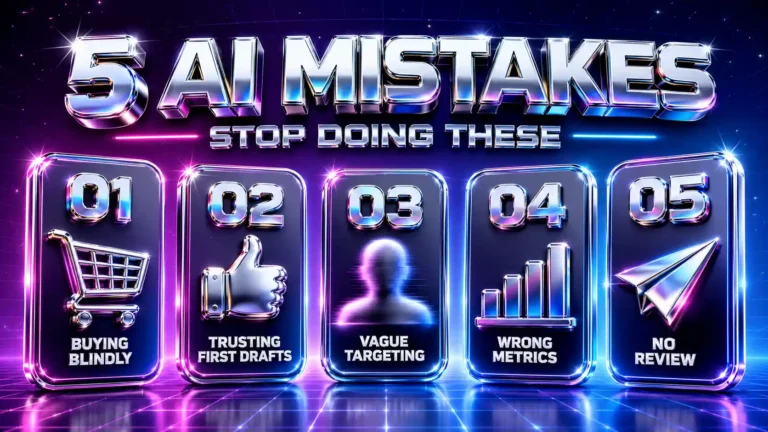
I’ve had this same conversation enough times that I can almost predict how it’ll go.
They buy the tool before they know what it’s for. This one’s so common it’s painful. Someone reads a Twitter thread, gets excited, signs up for a yearly plan, and then sits there wondering what to do with it. You’ve got the steps flipped. Live with whatever’s actually frustrating you for a bit. Let it really bug you. Then go looking for something that solves it. Not before.
They think the first thing the AI gives them is the answer. Whatever your writing tool spits out, that’s just raw material. A lump of clay. You still have to shape it before it’s worth anything. People who copy-paste it straight into their blog or caption and hit post, their audience can feel something is off even if they can’t explain why. And Google figures it out faster than your audience does.
They’re vague about who they’re even talking to. This kills me. “I want to reach small business owners.” Okay, but which ones? “A 38-year-old woman running a small biryani kitchen near Mavoor Road, watching her Saturday orders drop because her delivery app listing has no photos and a half-empty menu.” That’s a person. The first one is a category. AI works on what you feed it. Feed it a person, you get something useful. Feed it a category, you get the same generic stuff everyone else is publishing.
They count the wrong stuff. Number of posts published this week. Emails sent. Automations triggered. None of that is money. I’ve seen businesses celebrate “we posted every day this month!” while their phone hasn’t rung. Look, the only number that matters is the one that ends with someone paying you. The rest is just movement.
They let the AI publish without anyone reading it first. This one scares me a little. These models make things up. Stats it pulled from thin air. Quotes pinned to the wrong human entirely. Sentences that sound right until you actually check, and then they fall apart. If nobody is reading what your tool just wrote, you’re basically letting a confident stranger speak for your brand. Don’t do that.
Read those again slowly. Not one of them is about the AI. Every single one is about a decision a human was supposed to make and didn’t.
What a Real AI Marketing Strategy Looks Like
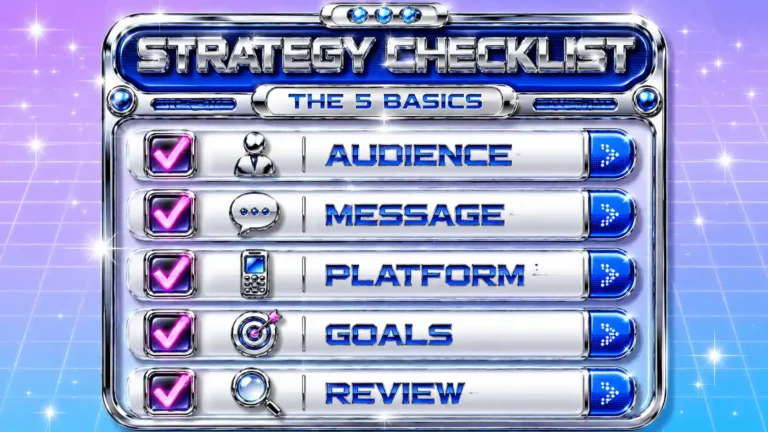
Before you touch a single tool, get honest about the basics.
A real strategy starts with knowing exactly who your customer is. Not “small business owners” but the actual person with the actual problem you fix. Age, location, what keeps them up at night, what they’ve already tried.
It means having a clear, plain message that says what you do and why anyone should care. If you can’t explain your business to a friend over chai in two sentences, no AI tool is going to explain it to a stranger online.
It means knowing where your customers actually spend time and showing up there consistently. Not everywhere. There. If your customers live on Instagram, posting on LinkedIn three times a week is a waste of your evenings.
It means setting goals you can actually count. “More engagement” is a wish, not a goal. “30 enquiries on WhatsApp by next month” is a goal. One you can hit or miss. One that tells you whether anything is working.
And it means sitting down every couple of weeks to look at what worked and what didn’t. Not just posting and hoping.
That’s the whole list. No fancy framework. No slide deck. No jargon. Just clarity before content.
Once that’s in place, AI becomes a multiplier. Without it, AI is just an expensive way to fail faster.
How Small Businesses in Kerala Should Actually Use AI
Most of the businesses I work with in Calicut don’t need a stack of premium tools. They need clarity and one or two AI tools used well.
Here’s a simple starting setup that works for almost any small business.
Use one AI writing tool to help draft content, but rewrite every output in your own voice before publishing. Use one scheduling tool to stay consistent on the platforms your customers actually use. Use AI inside Google or Meta ads to help with audience targeting, not to replace your judgement. And use one analytics tool to actually look at what’s working every two weeks.
That’s four tools, used with intention. It beats ten tools used in panic.
Frequently Asked Questions
Can AI write content for me?
It can help you draft content faster, yes. But it needs direction. Your voice, your audience, your point of view. Without that input, the output is generic and Google can spot it from a mile away.
Do I need a big budget to use AI marketing tools effectively?
Not really. What you need is a clear strategy, and that’s where most people underspend. A free tool used with purpose will beat an expensive one used with none.
I've been using AI but I'm still not seeing results. What's wrong?
Almost always it’s not the tool. Go back to the basics. Who is your audience? What do you want them to do? Why should they trust you? If you can’t answer those clearly, no tool will fix it.
Is AI-generated content bad for SEO?
Not automatically. Google penalises low-value, mass-produced content, not AI itself. If your content is genuinely useful, edited by a human, and shows real expertise, AI assistance is fine.
How do I know if my marketing strategy is weak?
Quick test. Can you explain who your customer is, what you offer, and why it matters in three sentences without using buzzwords? If not, your strategy needs work before any tool can help.
Tools Are the Engine. Strategy Is the Map.
Working as a digital marketer in Calicut, I’ve watched businesses get distracted by shiny software when the real gap was always in their thinking. The tools aren’t the problem. The order is.
Strategy first. Always. Once you know what you’re saying, who you’re saying it to, and what you want them to do next, the tools become genuinely powerful. That’s when AI starts paying off.
Final Thought
AI can’t rescue a broken strategy. But pair it with a sharp one, and the same tool starts feeling like a superpower.
If you’re pouring hours into your marketing and watching nothing come back, the answer isn’t another subscription. Step away from the dashboard. Sit with the real questions instead. Who are you actually for. What are you really selling. Why should anyone listening to you care. Once those answers are honest, then bring the AI back in. Let it speed up the work that deserves speeding up, not the work that shouldn’t exist in the first place.
Honestly, the sharpest tool in your marketing isn’t an app. It’s a clear head.
If you’d like a second pair of eyes on your strategy before your next tool purchase, reach out.
I write about marketing, strategy, and what’s actually working for small businesses in Kerala. If that sounds useful, find me on LinkedIn.